Views: 141 Author: Site Editor Publish Time: 2026-06-18 Origin: Site
Manufacturers processing sensitive materials often face unacceptable defect rates on the production floor. Thermal damage from standard fiber or CO2 lasers easily ruins delicate glass, medical-grade plastics, and thin silicon. You need a more precise, non-destructive alternative to maintain high product yields. The fundamental difference in a UV Laser Marking Machine lies strictly in its unique 355nm wavelength. It relies on photochemical ablation rather than raw thermal stress to create permanent marks. This highly controlled process drastically minimizes destructive heat transfer. Understanding this essential "cold marking" principle helps you evaluate the technology correctly. We will explore how these advanced systems justify their premium price points. You will also discover how to select the right wattage and match the ideal form factor to your specific production line.
Zero Heat-Affected Zone (HAZ): UV lasers break molecular bonds photochemically, preventing micro-fractures, burning, or melting on sensitive substrates.
Wavelength Dictates Precision: The 355nm ultraviolet wavelength offers a significantly smaller focal spot than 1064nm (Fiber) or 10600nm (CO2), enabling micro-level traceability codes.
Power Scales with Throughput, Not Just Depth: Upgrading from a 3W to a 5W system primarily increases processing speed and contrast efficiency, not necessarily engraving depth.
Form Factor Impacts Integration: Selection between desktop, mini, and cabinet configurations directly dictates production line scalability and Class 1 safety compliance.
Generating an ultraviolet laser beam requires complex internal optics. The system begins with a standard 1064nm infrared laser source. It uses third-harmonic generation (THG) to convert this beam. Nonlinear crystals shift the frequency first to 532nm green light. They then mix these frequencies to output a highly concentrated 355nm ultraviolet beam. This specific 355nm wavelength advantage defines the machine's capability.
Standard fiber lasers rely on the photothermal effect. They use intense localized heat to burn or melt the material surface. UV lasers behave entirely differently. They harness high photon energy to directly break the chemical bonds within the material. We call this the photochemical effect. The laser energy simply snaps the molecular chains apart. The targeted material vaporizes instantly before heat can transfer to surrounding areas.
Industry professionals refer to this as "cold processing." You must understand that "cold" does not mean zero heat exists. A minimal amount of heat still occurs during ablation. However, it remains strictly confined to the microscopic target area. This precise confinement completely eliminates the Heat-Affected Zone (HAZ). You avoid the warping or discoloration typically caused by peripheral thermal damage.
The business outcomes of this science are immediate. You achieve completely soot-free plastic marking. You can perform crack-free glass engraving on fragile vials. It easily generates the high-contrast, permanent marks required for FDA-compliant medical device UDI traceability. The science strictly protects your substrate integrity.
Certain manufacturing scenarios make photochemical ablation an absolute necessity. Plastics and engineered polymers react poorly to infrared heat. Materials like HDPE, PE, and ABS frequently suffer from foaming or charring under a fiber laser. The UV working principle prevents this thermal degradation entirely. It produces a smooth, tactile-free surface. You get exceptionally high-contrast marks that resist chemical wear.
Glass and ceramics demand a non-thermal approach. Fiber lasers pass right through transparent glass. CO2 lasers crack it through rapid thermal shock. Photochemical ablation is the only reliable method for these fragile substrates. It micro-etches the surface precisely. You avoid deep micro-cracking and prevent any critical structural integrity loss.
Circuit boards (PCBs) and silicon wafers present another strict compatibility threshold. These components feature densely packed, microscopic electronics. UV technology creates an ultra-small focal point, often under 10 micrometers in diameter. We utilize this focused beam for engraving micro-QR codes. It precisely removes the top solder mask layer. It never damages the sensitive adjacent conductive copper traces.
However, you must know when NOT to use UV technology. Do not deploy these systems for deep metal engraving. Do not use them for heavy-duty metal cutting. A standard fiber laser remains the far superior choice for robust metalwork. Fiber technology works much faster on raw steel and is significantly more cost-effective for deep penetration.
Material Compatibility Comparison Chart | ||
Material Type | UV Laser Performance | Fiber/CO2 Laser Risk Profile |
|---|---|---|
Medical-Grade Plastics | High contrast, no tactile distortion, soot-free. | High risk of melting, foaming, and toxic charring. |
Thin Glass / Vials | Smooth micro-etching without structural weakening. | Extreme risk of micro-fractures and immediate shattering. |
Silicon Wafers / PCBs | Ultra-precise ablation, harmless to micro-circuits. | High risk of short-circuiting adjacent conductive traces. |
Thick Metals / Steel | Slow, inefficient for deep engraving. Surface marks only. | Highly efficient, fast, capable of deep material removal. |
Choosing the correct power output requires understanding how cold processing scales. In traditional laser cutting, higher wattage equals deeper cuts. This logic fails with ultraviolet technology. In a UV system, higher wattage translates directly to faster pulse repetition rates. It provides higher throughput rather than deeper penetration. You are buying speed and contrast efficiency.
A 3W UV Laser Marker excels in very specific operational environments. It works perfectly for low-to-medium volume production runs. We frequently recommend it for static component marking. It handles highly sensitive, ultra-thin materials beautifully because its peak power remains gentle. The primary trade-off is cycle time. You will experience slower operational speeds on heavily automated production lines.
Conversely, a 5W UV Laser Engraving Machine dominates fast-paced manufacturing. It shines in high-speed, continuous "mark-on-the-fly" conveyor setups. The higher repetition rate creates overlapping pulses rapidly. This produces exceptional surface contrast on tough polymers. The trade-offs include a higher initial capital expenditure. It also requires slightly increased cooling capacities to maintain optical stability.
3W Power Profile: Ideal for precision manual loading stations, single-batch processing, and ultra-thin glass components.
5W Power Profile: Mandatory for automated extrusion lines, high-speed PCB tracking systems, and difficult-to-mark colored plastics.
Scaling Factor: Moving beyond 5W (e.g., 10W or 15W) is generally reserved for specialized industrial micromachining, not standard coding.
Technology selection extends beyond the laser source itself. The physical enclosure dictates how safely and efficiently the machine operates within your facility. You must align the structural form factor with your strict production realities.
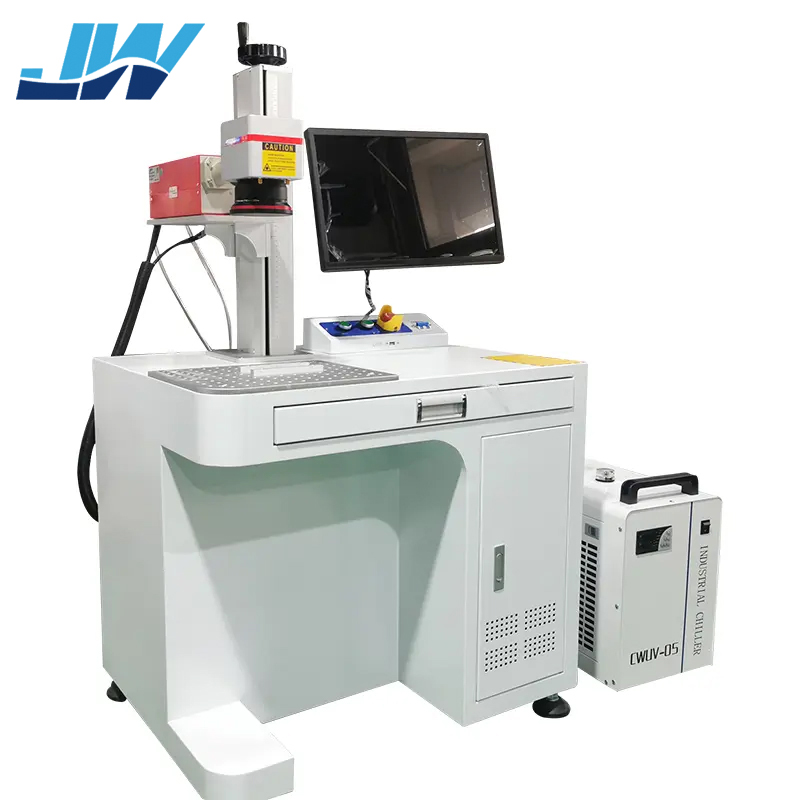
A Desktop UV Laser Marking Machine balances a compact footprint with full-feature capability. It sits comfortably on standard industrial workbenches. We consider this setup ideal for localized work cells and batch processing tasks. It serves QA testing labs perfectly. Operators can easily manually load parts while maintaining excellent control over the focal distance.
A Mini UV Laser Marking Machine represents a highly portable configuration. It provides a lower-cost entry point for small-scale workshops. Bespoke electronics repair technicians often prefer this minimal setup. However, you must respect its implementation risks. A mini system frequently lacks robust fume extraction capabilities. It rarely includes the comprehensive enclosure safety features required for high-volume industrial use.
For large-scale factory integration, a Cabinet UV Laser Marking Machine remains the undisputed industrial standard. The full steel enclosure ensures strict Class 1 laser safety compliance. This protects floor workers from stray ultraviolet radiation.
When selecting a form factor, follow these core integration steps:
Audit Your Floor Space: Measure available benchtop or floor area before committing to an enclosure style.
Determine Automation Needs: If you require automated Z-axis adjustments or rotary attachments, cabinet models offer superior structural rigidity.
Assess Safety Regulations: Mandate fully enclosed cabinet models for factories requiring strict OSHA or CE compliance.
Plan Material Flow: Ensure the chosen form factor accommodates the physical size of your largest manufactured parts.
Deploying ultraviolet laser technology introduces specific maintenance responsibilities. You must understand crystal degradation. The specialized harmonic crystals used to generate the 355nm wavelength slowly absorb energy over time. They have a finite operational lifespan. You can typically expect 15,000 to 20,000 working hours from these optical components. They degrade much faster than standard fiber laser diodes. Power output will eventually drop, requiring recalibration or module replacement.
You must also manage strict chiller requirements. Maintaining stable continuous output demands aggressive thermal management. Most 3W and 5W systems require closed-loop water chillers. Deionized water cooling provides the exact temperature control necessary to maintain internal beam quality. Air cooling works for some low-power models, but water cooling guarantees long-term stability.
Fume extraction represents another critical implementation risk. Many operators wrongly assume that "cold" photochemical ablation is entirely clean. While it prevents smoke, ablation produces invisible nanoparticle dust. Micro-plastics and silica particles become airborne instantly. Workplace compliance requires integrated fume extraction systems (FES) equipped with HEPA and activated carbon filtration.
Your shortlisting next steps should focus heavily on empirical data. Do not guess your machine requirements. We strongly recommend requesting vendor sample testing. Send your specific production materials to the manufacturer's lab. Test them under different wattages before finalizing your enclosure type.
The working principle of UV lasers fundamentally shifts the manufacturing paradigm. It replaces aggressive thermal burning with precise, molecular-level ablation. This technology serves as the ultimate solution for traceability on heat-sensitive materials. It delivers micro-precision that older optical systems simply cannot match.
Base your final procurement on a rigid matrix of your specific operational constraints. Evaluate your cycle-time requirements carefully when choosing between a 3W and 5W system. Do not overlook your facility safety protocols when deciding between a desktop, mini, or fully enclosed cabinet framework. Aligning these factors ensures consistent, compliant production yields.
We urge you to prioritize real-world validation. Submit your exact material samples for professional lab testing. Verify the mark contrast, check the processing speed, and confirm your exact wattage requirements. Always secure this empirical evidence before requesting a formal equipment quote.
A: The high cost stems from its complex internal architecture. Generating a 355nm wavelength requires diode-pumped solid-state lasers paired with expensive frequency-tripling harmonic crystals. These highly engineered, sensitive optical components drastically drive up manufacturing and assembly costs compared to simpler fiber optic systems.
A: Yes, it can. UV lasers create highly precise, high-contrast surface marks on metals like surgical stainless steel. However, they are highly inefficient for deep metal engraving. If you need deep cuts or rapid metal ablation, a fiber laser remains the superior choice.
A: The internal harmonic crystals typically last between 15,000 and 20,000 working hours. Toward the end of the crystal's life, you will notice the power output gradually decrease. This degradation eventually requires recalibration or a complete laser source replacement to maintain marking quality.
A: Generally, yes. While some entry-level low-power models use air cooling, 5W industrial systems generate more internal heat. They rely heavily on closed-loop water chillers to maintain strict thermal stability. This strict temperature control protects the internal optical crystals and ensures consistent beam quality.

 English