Views: 135 Author: Site Editor Publish Time: 2026-08-20 Origin: Site
The rapid adoption of handheld fiber laser technology has introduced multi-process systems claiming to weld, clean, and cut with a single unit. For fabrication shops handling diverse metal plates, pipes, and complex profiles, these machines promise massive space and capital savings. Buyers face conflicting information. Manufacturers market these systems as revolutionary all-in-one solutions, while industry forums often dismiss them as compromised "jack-of-all-trades" tools or mere publicity stunts that fail to match the pristine weld seams or cleaning speeds of dedicated, single-purpose machines. To make a financially sound procurement decision, fabricators must look past the marketing. This guide breaks down the technical realities, power requirements, and supplier evaluation frameworks necessary to determine if a multi-function fiber laser system aligns with your production needs.
Versatility vs. Specialization: 3-in-1 systems offer legitimate value for low-to-medium volume, mixed-process environments, but high-volume production lines still benefit from dedicated single-process machines for optimal seam quality and speed.
Power Dictates Capability: Selecting between a 1500W, 2000W, or 3000W system drastically alters the machine's penetration depth, cleaning width, and continuous operating limits across different metals.
The Cutting Compromise: While marketed as a welding, cleaning, and cutting machine, the cutting function is strictly for rough, manual trimming of thin materials, not a replacement for precision CNC flatbed lasers.
Component Quality is Paramount: The true differentiator between a reliable tool and a maintenance liability lies in the laser source brand, the wobble head design, wire feeder integration, and the chiller capacity.
Supplier Due Diligence: When sourcing a laser welding cleaning machine China supplier, prioritizing English-speaking technical support, component transparency, and verifiable warranty terms is more critical than the base unit price.
Industry skepticism heavily surrounds multi-process laser tools. Fabrication professionals on Reddit and Quora frequently label these machines as publicity stunts. They argue the weld seams look inferior compared to single-purpose welders and that the cleaning function lacks the raw impact of traditional sandblasting. We must address this skepticism directly to understand the actual capabilities of the equipment. Early adopters experienced genuine issues with focal lengths and optical stability. The technology has evolved significantly since those first iterations hit the market.
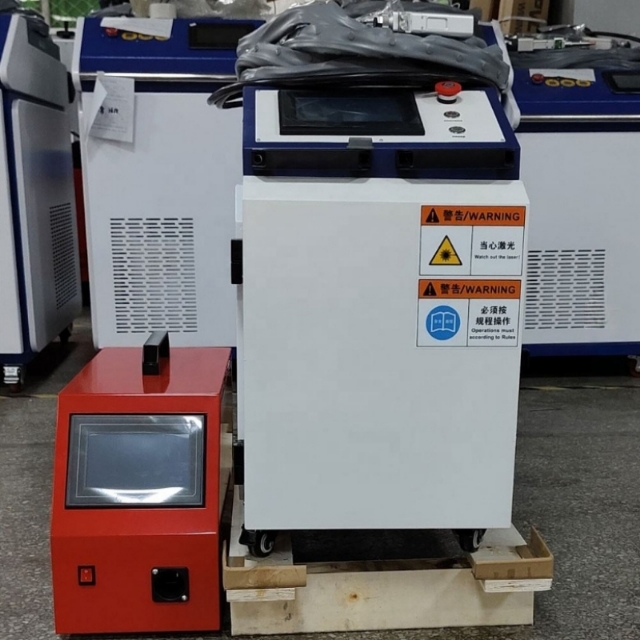
A modern fiber laser welding cleaning machine operates using a single, high-power continuous wave laser source. It relies on interchangeable copper nozzles and focal lenses housed within the handheld torch. Operators select different software profiles on the digital control screen to change the beam's behavior. The system shifts from a high-density, narrow welding beam to a rapidly oscillating cleaning beam. The cleaning mode widens the laser path considerably, often up to 80mm wide. It vaporizes surface contaminants through a process called laser ablation. The high-peak power pulses hit the rust, oil, or paint. The contaminant absorbs the energy, expands, and vaporizes instantly. The base metal reflects the 1064nm wavelength beam. This leaves the substrate completely undamaged. This selective vaporization makes laser cleaning superior to traditional abrasive blasting because it creates no secondary waste media to sweep up or dispose of.
We must address the inferior seam myth. Early models produced worse welding seams because they compromised focal lengths. Engineers tried to accommodate both cleaning and welding with static optics, resulting in a beam that was never truly optimized for either task. Modern units solve this problem entirely. They use sophisticated dual-axis wobble heads equipped with internal galvanometer mirrors. They also feature synchronized automatic wire feeders. These components bridge the performance gap. They allow for high-quality seams on plates, pipes, and profiles. The laser beam oscillates in multiple patterns, such as figure-eights or circles. This action stirs the weld pool, allows outgassing of impurities, and improves joint strength. It also forgives slight fit-up gaps that would ruin a static laser weld.
Every fabrication tool comes with specific trade-offs. You must weigh the mechanical features against your desired production outcomes.
Reduced footprint saves valuable floor space in crowded job shops.
Lower initial capital expenditure beats buying three separate, dedicated machines.
High mobility allows for field work and tight shop floor navigation. You can roll the unit directly to heavy structural workpieces instead of moving the steel to a welding cell.
Frequent lens and nozzle changeovers disrupt continuous workflow. Swapping from welding to cleaning takes a few minutes, which adds up during high-volume production.
A failure in the main laser source halts all three processes simultaneously. You lose your welder, cleaner, and cutter in one breakdown.
Cutting capabilities remain strictly limited to thin sheet metal. You cannot use this to replace a CNC plasma or flatbed laser for precision parts.
Comparison of Metal Preparation Methods
Preparation Method | Secondary Waste | Base Metal Damage Risk | Setup Time | Consumable Cost |
|---|---|---|---|---|
Laser Cleaning (Ablation) | None (Fumes only) | Extremely Low | Under 2 minutes | Low (Electricity, Lenses) |
Abrasive Sandblasting | High (Spent media) | Moderate (Surface pitting) | High (Containment needed) | High (Media replacement) |
Mechanical Grinding | Moderate (Dust, shavings) | High (Material removal) | Instant | Moderate (Abrasive discs) |
Chemical Solvents | High (Toxic runoff) | Low | Moderate (Application/Wait) | High (Chemical purchase/disposal) |
A 1500W laser welding and cleaning machine serves specific, lighter-duty fabrication needs. Thin sheet metal fabrication excels in this power bracket. It handles up to 3mm stainless or carbon steel effortlessly. It performs light surface rust removal perfectly. Pre-weld oil cleaning works flawlessly. It is excellent for intricate profile work where heat input must remain low to prevent warping. Cabinet makers, food-grade stainless fabricators, and HVAC duct shops benefit greatly from this size. The lower heat-affected zone (HAZ) keeps thin materials from distorting.
This power level carries distinct limitations. It lacks the raw energy for deep penetration welding on structural steel. Highly reflective metals pose a serious challenge. Thick aluminum or copper will deflect the beam and risk back-reflection damage to the fiber optic cable. Heavy mill scale removal takes too much time at 1500W. You will experience slower travel speeds on anything thicker than 11-gauge steel, forcing the operator to slow down and potentially input too much heat.
A 2000W laser welding and cleaning machine represents the industry sweet spot. It perfectly balances power, operating cost, and portability. It easily welds 5mm to 6mm materials in a single pass. Joining structural pipes and square tubing becomes highly efficient. It strips heavy paint, oxidation, and rust quickly. It achieves this without causing excessive thermal distortion in the base material. Most general job shops find this wattage ideal for daily mixed use. It provides enough power to overcome the reflectivity of 6061 aluminum up to 4mm thick.
The limitations are manageable but require attention. It requires more robust cooling than lower power models. Higher power consumption demands proper electrical infrastructure in your shop. You cannot run this on standard lightweight circuits; it typically requires a dedicated 220V single-phase or 380V three-phase drop. The protective lenses degrade slightly faster due to the increased energy output, requiring operators to inspect the optics daily.
A 3000W laser welding and cleaning machine tackles serious industrial tasks. Heavy structural fabrication fits this category perfectly. Thick plate welding up to 8mm or 10mm becomes entirely possible with proper joint preparation. Rapid, wide-pass industrial cleaning saves massive labor hours. You can strip thick marine coatings, heavy industrial rust, or thick mill scale in seconds. Shipyards, heavy equipment repair facilities, and structural steel shops rely on this power level to replace traditional submerged arc or heavy flux-core welding.
The drawbacks center around size, safety, and consumable wear. The unit is significantly heavier. It is less portable around a crowded shop floor. It requires an industrial-grade dual-temperature chiller to prevent the laser source and the handheld gun from overheating. It poses much higher safety risks. Operators must maintain strict PPE compliance. The intense scattered light requires fully enclosed, laser-safe workspaces with interlocked doors. Spatter is more violent at 3000W, meaning protective glass lenses in the torch will need frequent replacement if the operator uses incorrect gas flow rates.
You must evaluate the engine of the machine first. Laser source reliability dictates the lifespan of your investment. Compare top-tier sources like IPG against reliable mid-tier options. Brands like Raycus, MAX Photonics, and JPT dominate the global market. IPG offers unmatched beam stability, excellent beam parameter product (BPP), and global support. Raycus and MAX provide excellent value and proven durability for standard fabrication tasks. The source determines your beam quality and long-term degradation rate. A cheap, unbranded laser source will lose output power within the first year, turning a 2000W machine into a 1500W machine.
The handheld gun's internal motors matter greatly. You must inspect the wobble head and optical design. Look for dual-axis wobble capabilities. These allow for wider cleaning paths, often reaching up to 80mm or 100mm depending on the focal lens. They provide better gap-bridging during welding operations. Single-axis heads limit your operational flexibility. Traditional fixed-optic laser welders required perfect fit-up. A gap of 0.5mm would cause the beam to fall right through the joint. Internal galvanometers in a dual-axis head spin the beam at high frequencies. They create figure-eight, circular, or linear patterns. This widens the effective beam diameter. It allows operators to bridge gaps up to 1.5mm easily when combined with filler wire.
Wire feeder integration is a critical component for structural welding. Evaluate the machine setup carefully. It must include a fully integrated, synergic wire feeder. This device automatically adjusts wire feed speed based on the laser power output and the selected software parameters. It ensures smooth, consistent seams across long runs. A push-pull wire system prevents bird-nesting when using soft aluminum wire like ER4043. Do not accept a machine with a basic, non-synergic feeder that requires manual speed dialing independent of the laser controls.
Integrated water chillers are an absolute necessity. Fiber lasers generate massive heat. The electro-optical conversion efficiency hovers around 30% to 35%. The rest becomes thermal energy. A dual-temperature chiller splits the cooling loop. One loop cools the laser source. The second loop cools the optics in the handheld gun. If the gun overheats, the focal lens expands. This shifts the focal point. We call this thermal lensing. It destroys weld penetration, causes erratic spatter, and ruins the lens rapidly. Ensure the chiller uses distilled or deionized water to prevent scale buildup inside the cooling channels.
Assess the cart design and ergonomics thoroughly. Check the umbilical cable length. It typically ranges from 10m to 15m. A longer cable provides better reach for large weldments but requires careful handling to avoid fiber breakage. Evaluate the weight of the handheld torch. A heavy torch causes severe operator fatigue during long shifts. The trigger mechanism should feel natural and responsive, with a dual-safety interlock to prevent accidental firing.
Calculate the hidden operational expenses before buying. You will frequently replace protective lenses and copper nozzles. Factor in the cost of shielding gas. You need Argon or Nitrogen for proper welding execution. Nitrogen works well for stainless steel, keeping the weld face bright and silver. Argon provides excellent coverage for aluminum and carbon steel. Ensure your local gas supplier can meet the flow rate demands of continuous laser welding, which often requires 30 to 40 CFH (Cubic Feet per Hour) to adequately protect the weld pool and the torch optics from spatter.
Shielding Gas Selection Guide
Base Material | Recommended Gas | Typical Flow Rate (CFH) | Primary Benefit |
|---|---|---|---|
Carbon Steel | Argon or Argon/CO2 Mix | 30 - 40 | Stable arc, excellent puddle control, low cost. |
Stainless Steel | Nitrogen | 35 - 45 | Prevents oxidation, maintains bright silver weld finish. |
Aluminum | 100% Argon | 40 - 50 | Breaks up oxide layer, prevents porosity in the weld. |
Galvanized Steel | Argon | 35 - 45 | Helps manage zinc outgassing and reduces violent spatter. |
Evaluating a laser welding cleaning machine China supplier requires strict diligence. You need a framework for separating actual manufacturers from trading companies. Many companies claim to manufacture laser machines. Most simply assemble parts in a small warehouse or act as middlemen. Ask for a live video tour of their assembly floor. Request to see their aging testing room. Quality manufacturers run their laser sources for 48 hours before shipping. This burn-in period catches early component failures and ensures the chiller maintains temperature under continuous load.
When testing materials, send your own metal samples. Do not rely on their pre-polished test coupons. You need to see how the machine handles your dirty, real-world steel. Request unedited video demonstrations of your specific material types. Watch them weld aluminum pipes. See them clean rusted carbon steel plates. Verify CE and FDA certifications for laser safety compliance. Fake certificates run rampant in the industry. Check the certificate number against the issuing body's database to ensure the machine meets international electrical and radiation safety standards.
Buying a wholesale 3 in 1 laser machine involves different considerations. Distributors or large shops outfitting multiple stations must plan ahead. Negotiate spare parts packages into the wholesale contract. Ask for extra protective lenses, copper nozzles, focus lenses, and fiber cables. This minimizes future downtime. Ensure the supplier guarantees component availability for at least five years. Discuss volume discounts, but never compromise on the chiller capacity or laser source brand to lower the unit price. A cheap chiller will destroy an expensive laser source.
Remote troubleshooting across time zones is a harsh reality. Access to localized technicians is ideal but rare. Highly responsive video-call support acts as a non-negotiable success criterion. A machine sitting idle costs money every hour. Your supplier must provide immediate technical feedback via WhatsApp or WeChat. Ask about their warranty claim process. Determine who pays for shipping if a major component fails. A strong supplier will ship replacement parts immediately upon diagnosing the issue via video, rather than waiting for you to ship the broken part back first.
Measure the maximum thickness of the materials you process daily to determine the exact laser wattage required for your shop.
Calculate your current monthly expenses on grinding discs, flap wheels, and chemical solvents to establish a baseline for your return on investment.
Request a live video demonstration from the supplier showing your specific joint configurations and material grades being welded and cleaned.
Upgrade your shop's electrical infrastructure to support the high-amperage, 220V or 380V requirements of the chiller and laser source.
Order a comprehensive spare parts kit alongside the machine, including at least 50 protective lenses and a variety of copper nozzles, to prevent immediate downtime.
A: They can cut thin metals manually, but lack the precision, edge quality, and automation of dedicated laser cutters. The cutting function is best used for rough, on-the-fly trimming of plates and pipes, not precision fabrication.
A: Swapping the nozzle, changing the focal lens, and selecting the new software parameter typically takes a trained operator 2 to 5 minutes.
A: Because of aluminum's high reflectivity and thermal conductivity, a 1500W unit can only handle thin aluminum (1-2mm). A 2000W+ system is highly recommended for stable, high-quality aluminum processing.
A: Early models compromised the focal length to allow for both cleaning and welding. Modern units solve this with interchangeable lenses and dual-axis wobble heads. Using the included wire feeder also ensures the seam quality matches or exceeds traditional TIG/MIG welding.
A: Protective lenses, focusing lenses, copper nozzles, wire feeder tips, and shielding gas (Argon or Nitrogen).
A: These are Class 4 lasers. Safe operation requires OD6+ laser safety glasses, enclosed laser-safe workspaces, proper ventilation for cleaning fumes, and full-body skin protection to prevent radiation burns.
A: Price variance is driven almost entirely by the brand of the laser source, the quality of the water chiller, the inclusion of an automatic wire feeder, and the level of post-sale technical support provided by the supplier.

 English